Moving on
We’ve been prepping my childhood home for an estate sale taking place in a few weeks, and my primary task has been getting my remaining unsalable old junk out of there. A lot of it has turned out to be assignments from college: a big stack of portfolios filled with charcoal nudes and various graphic design things mounted on black boards with tracing paper overlays for professors’ commentary. Sketches, marker comps, paste-ups, digital prints. Typesetting, hand-lettering, illustrations, logos, letterheads, envelopes, business cards, brochures, posters, menus, mailers, advertisements, calendars, magazines.
I thought going through them all would be fun and nostalgic, if somewhat cringey. Maybe this expectation was fueled by an unacknowledged predilection for remembering my college days through a pleasant social lens rather than a fraught academic one, but I was unprepared for the overwhelming existential dread baked into the work. It’s not that I had forgotten about my poor performance as a student, it had just been a while since I properly marinated in how consistently poor it was. Decades later, some of my professors’ entirely valid comments still sting. Looks like a rush job. Needs more development. You need to stop procrastinating. What the comments qualified, my grades quantified: my transcript shows a 2.34 cumulative GPA, a feat achievable only after making up the 11 classes I failed, three of them in my major.
For the duration of my prolonged, eleven-semester stretch as an undergrad, I was stressed out full-time. I was constantly behind and unprepared, more often than not turning in work that was late and/or rushed. I got through it by convincing myself I really did care and I really was capable of much better, but apart from a few bright spots, there just wasn’t much evidence to support that.
Though I arguably matured and did better in the working world, adulthood and professional life didn’t flip some magic competence switch. I’ve lucked into associations with people and organizations of earned prestige, and I’ve done some work I’m proud of, but I’ve also disappointed clients and employers who had reason to expect more than they got. I still characteristically struggle with motivation, time management, and team dynamics, and I’ve been fired for cause more than once. Full-time jobs account for less than a third of my career, and the freelance work making up the balance has mostly been a hand-to-mouth grind. Retirement probably isn’t in the cards.
That persistent, self-loathing stress from my undergrad days never really went away; I just learned to live with it. But my defenses are wearing thin, and I’m tired.
The point here isn’t to beat myself up or feel sorry for myself, nor to suggest that institutional validation, academic or professional, has some intrinsic value. You may have had a bumpier road in school and work than I, and I wouldn’t dare judge you for that. The point, I think, is that for better or worse, we live in a society in which survival is predicated on economic participation, and I’m starting to realize the role I’ve made for myself hasn’t been a great fit.
I don’t pretend what I’m going through is unique. Today is my 50th birthday and I’m doing the mundane work of taking stock in the middle of a perfectly cliché midlife crisis. But I guess now is as good a time as any to finally learn that the work ain’t gonna do itself. So let’s see if I can’t find a path forward.
I got into graphic design because I wanted to make visual things, and a fine-art career seemed too steep a hill to climb. Form was the goal, function was the compromise. Over time, though, my work’s function flattened its form, and I lost touch with why I was doing it in the first place. I was convinced my creative skills were best put towards practical solutions to other people’s problems, and the more invisible my contribution, the better. I still believe there’s nobility in that pursuit, but the title of a talk I once gave about my journey, “From Self-Centered to User-Centered,” now strikes me as a false dichotomy. Reconnecting in recent years with making art for art’s sake, work that’s meant to be looked at rather than through, work that’s more about indulging curiosity than satisfying objectives, has been far more invigorating than any functional client work I can think of. And sure, many creative professionals would say the same of their own work. I’m just not so sure anymore that the creative me and the professional me need to have any association. So much of my favorite art is basically allergic to sustainable commerce, and my own attempts to bridge that gap are eating me alive.
Creativity is a muscle. Exercise it often to make it grow and keep it strong. But maybe what I’ve overlooked is that even the strongest muscles can’t flex all the time. They need rest. And when my creative energy prioritizes getting paid, there’s too often not enough left in the tank for the work that truly feeds me. All of the work, professional and personal, suffers as a result.
So I think I’m ready to be more protective of my creative energy and find a different way to get paid. How I’ll do that is an open question, but there was something else I found in those old piles of college stuff which may be instructive: a flyer for a hardcore show I attended in 1996. I keep a concert diary and that show was already logged there, but the flyer revealed that my diary entry not only failed to note two of the bands that played, the entry also had the wrong date. I was thrilled to be able to make these corrections, doubly so with the help of a physical artifact I thought had been lost to time. The concert diary is one facet of my website, which is essentially a carefully organized archive of almost everything I’ve chosen to share of myself online over the course of many years. As historical records go, it’s by no means important, at least not to most people who aren’t me, but I wonder if the kind of care I’ve put into it might be valuable to other historical records. My plan, then, is to learn more about the world of archivists and see if there’s a place there for me. If you know anything about the field, I’d love to hear from you.
A career change won’t solve all my problems. Neither art nor job will be easier just because I’ve decoupled them. Anxiety and distraction and bad habits will persist. Some therapy is probably a good idea. And who knows where we’ll all end up if the AI overlords have their way. All I can do is try my best. Here’s hoping that’s good enough.
More personal posts
Jack
It bothers me that I can’t remember exactly when and where I met Jack. I’m usually pretty good about that. It was probably 2007-ish, probably at SXSW or An Event Apart. I was going to a lot of conferences back then, meeting all kinds of web people from all over the place, and Jack was a web person, though we didn’t talk about the web all that much once we found other things we had… See more →

I was at a funeral today and felt all the appropriate funeral feelings but I also could not stop thinking about Coffin Flop
That was 2025
I got a speeding ticket the other day, my first in probably more than 25 years. After a decade and a half of not owning a car, L and I reluctantly accepted a hand-me-down Hyundai Tucson a couple years ago so we could be more nimble for the sake of our aging parents. Not coincidentally, I’ve been driving it a lot lately, making regular visits to the memory-care residence my mom now calls home, or… See more →
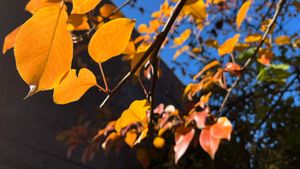
I don’t know if it’s because some new responsibilities are taking me out of the house more than usual, or because humanity’s current ugly streak makes everything else look more beautiful, or because the chlorophyll decided now was the time to leave it all on the stage, but I’m really noticing the fall colors this year. Waking up to this radiant pear tree outside our window has been a quiet blessing.
The Burger King bathroom
It seems like a cliché for a drug dealer to be working his stash out of a Burger King bathroom, but I hadn’t personally encountered it before. Or if I had, the operation was more subtle than this guy’s.
Not that he needed to be subtle. The place was mostly deserted, as often seems to be the case for legacy fast-food joints in the 21st century, at least in the suburbs. When did people stop… See more →
TWENTY YEARS!

The Diary of a Young Girl
When I changed high schools after the ninth grade, there was some confusion about how each school handled its history curriculum, and in the shuffle, I lamentably never got a formal education in 20th century world history. I assume this is why I was never required to read this book. Reading it now, decades late to the, uh, party, it’s hard not to wonder how it would have affected me as a teen.
Would it… See more →
After a long day, as I made my dejected drift toward Suburban Station’s 18th Street exit, I saw a mural cheerfully proclaiming, “My art gives me a voice,” to which I was startled to find myself reflexively responding aloud, “Oh, that’s cool. Mine slowly fucking kills me.”
That Was 2024
My year in review
I was hopeful, if not naive enough to be confident, that enough people were sufficiently fed up with That Fucking Guy to keep him from returning to the White House. But he will, of course, be returning, and while this time his victory isn’t the shock to the system it was in 2016, his popular vote win, a hair shy of a mandate, still stings plenty. The Democratic Party’s subsequent soul-searching might be morbidly comical… See more →